Windows 10 News · October 2026
Windows 10.Playable.Dead.
Yes, you can keep gaming on Windows 10 after October 2026. But this month, NVIDIA ships its last Game Ready driver for Windows 10 and FACEIT tightens its rules. Nearly one Steam player in four is still affected. Here is what actually stops, what keeps working, and how to tell where your PC stands.
Measure before upgradingLatence runs on Windows 10 and 11: it measures whether upgrading really changes anything on your PC.
The gist in 30 seconds
Your games, Steam and your current driver keep working after October.
Last Game Ready driver for Windows 10 this month, then security fixes only until 2029.
From October 14: Windows 10 22H2 with ESU enabled. Windows 11 after October 2027.
A PC that was never enrolled is not covered. The program ends on October 12, 2027.
Contents
Four layers, four timelines
"Can I still play?" bundles four questions. Windows, the graphics driver, the launcher and the game each follow their own timeline.
Each layer of your PC follows its own schedule, set by a different company:
- Windows and its security fixes: Microsoft.
- The graphics driver: NVIDIA, AMD or Intel.
- The launcher: Steam, Epic, Battle.net…
- The game and its anti-cheat: each publisher or platform.
A game can run perfectly well on a Windows install that no longer gets any fixes. Conversely, an up-to-date Windows can be rejected by an anti-cheat that demands other settings. The riskiest mix-up: "NVIDIA patches its drivers until 2029, so my Windows 10 is protected until 2029." It is not. Driver fixes do not replace operating system fixes.
The timeline, deadline by deadline
Eight dates matter, from October 2025 to October 2029. Two land this month: NVIDIA's last Windows 10 driver and FACEIT's October 14 rule.
- End of standard Windows 10 support
No more fixes or assistance, except for PCs enrolled in ESU.
- GeForce GTX 900 and 1000 (Maxwell, Pascal, Volta)
No more Game Ready drivers, on Windows 10 and Windows 11 alike. Security fixes until October 2028.
- Steam on 32-bit Windows
Steam no longer updates its client on 32-bit Windows. 64-bit Windows 10 is still supported.
- Last NVIDIA Game Ready driver for Windows 10
Drivers from November 2026 onward no longer support Windows 10. Studio drivers follow the same plan.
- FACEIT on Windows 10
Windows 10 22H2 with ESU enabled is required. Some PCs may have to move to Windows 11 sooner.
- End of the consumer ESU program
No more Windows 10 security fixes for home users.
- FACEIT requires Windows 11
Windows 10 is no longer accepted by FACEIT Anti-Cheat. No exact day announced.
- NVIDIA security fixes for Windows 10
Quarterly driver security updates, with no optimizations for new games.
ESU: what it covers and how to turn it on
ESU only extends security fixes for Windows 10 22H2, until October 12, 2027. A PC that was never enrolled is not covered.
ESU (Extended Security Updates) only extends critical and important security fixes for Windows 10. It brings no new features, no ordinary bug fixes and no technical support. It only applies to Windows 10 version 22H2.
The key point: a PC that was never enrolled is not covered automatically. Only PCs already enrolled are extended to October 12, 2027 with no action needed. You can enroll at any time before that date.
Enrollment options depend on where you live
- United States (per Microsoft's US page): free if you sync your PC settings, by redeeming 1,000 Microsoft Rewards points, or with a one-time $30 purchase plus tax.
- European Economic Area: free as long as you keep signing in to Windows with your Microsoft account. If you stop, updates are interrupted after up to 60 days and you must re-enroll. A one-time purchase lets you keep a local account instead.
- Elsewhere: options and prices vary. Check Microsoft's ESU page for your country before choosing.
Check or turn on ESU
Settings › Update & Security › Windows Update.
If your PC is eligible and not enrolled yet, an "Enroll now" link appears.
You need an administrator account and a Microsoft account (not a child account).
This guide is about personal PCs. Work PCs joined to a domain or managed by a device management tool fall under a separate, commercial ESU program.
Graphics drivers: NVIDIA, AMD and Intel
The NVIDIA driver you already have keeps working. What stops after October 2026 are optimizations for new games.
NVIDIA: the end of optimizations, not of the driver
The driver you already have does not switch off. What stops after October 2026 are game profiles and optimizations for new releases, new features and compatibility fixes. Games supported by the last driver keep working. A game released in 2027, however, may run worse, or poorly, without a matching driver.
Older cards are a special case. GeForce GTX 900 and 1000 series cards (such as the GTX 1060 or GTX 1080) already moved to security-only updates in October 2025, until October 2028. For them, moving to Windows 11 brings back no Game Ready drivers. Only GTX 16, RTX 20 and newer cards (Turing, Ampere, Ada, Blackwell) keep receiving them.
AMD and Intel: a separate schedule
NVIDIA's timeline does not apply to other brands. The release notes for AMD Adrenalin 26.9.2, published in September 2026, still list Windows 10 64-bit (21H2 or later) as supported. That does not guarantee unlimited support: check the notes of each new driver. To pick the right moment to update, read our GPU drivers for gaming guide.
Steam and your games
Steam is not dropping Windows 10. It only ended support for 32-bit Windows, on January 1, 2026.
32-bit Windows is used by a tiny fraction of players. 64-bit Windows 10 is still supported, and 32-bit games still run on 64-bit Windows.
Each game then sets its own minimum requirements. Counter-Strike 2, for example, still lists Windows 10 as its minimum operating system on Steam. Its built-in anti-cheat is Valve's VAC.
FACEIT: the current rule
FACEIT on Windows 10? 22H2 with ESU enabled from October 14.
After October 2027, Windows 11 will be required, in line with the end of ESU. Some PCs may have to upgrade sooner, depending on their configuration.
FACEIT is not CS2's anti-cheat: it is a separate match platform with its own anti-cheat. A FACEIT restriction does not block CS2 in Valve matchmaking.
An early 2025 announcement said Windows 11 would be required in October 2026. That is no longer the rule: the rule above comes from FACEIT's official FAQ, updated in early October 2026.
The Windows version is only part of the requirements. FACEIT also asks for TPM 2.0, Secure Boot and, rolled out in waves, IOMMU with virtualization-based security (VBS). These protections notably block cheat cards that read game memory.
Watch out with optimization tools. Some, Latence included, offer to turn off VBS or memory integrity for a small performance gain. If you play on FACEIT, keep them on: without them, the anti-cheat will reject your setup.
Your situation in five minutes
Five facts are enough to know where you stand. Note them down before deciding anything.
- Your Windows version. Press Windows + R, type
winver, press Enter. You need to see "Version 22H2" to be eligible for ESU. - 32-bit or 64-bit. Settings › System › About › System type.
- Your ESU enrollment. Settings › Update & Security › Windows Update.
- Your exact graphics card. A GTX 1000 card and an RTX 3060 do not follow the same timeline.
- Your games and platforms. FACEIT, ranked games, kernel-level anti-cheats: also note any anti-cheat error message.
You also need TPM 2.0, Secure Boot and VBS. Plan for Windows 11 before late 2027.
Enroll in ESU to stay protected until October 2027, and plan your move for games released after that.
Your driver will get no more optimizations. Switching operating systems changes nothing on that front.
On Windows 10, that driver stays the last one. Optimizations for 2027 games will only come on Windows 11.
Your PC is not eligible for Windows 11
Start by checking what is blocking. On many gaming PCs, the TPM or Secure Boot exists but is simply turned off in the BIOS.
The TPM is labelled fTPM on AMD and PTT on Intel. Secure Boot also needs a GPT-formatted drive. Microsoft's PC Health Check app shows what is blocking.
If the hardware really is too old, your realistic options are:
- Stay on Windows 10 with ESU until October 12, 2027, knowing FACEIT will stop accepting it afterwards.
- Replace parts when your budget allows, rather than in a rush: the ESU deadline leaves a year.
- Avoid Windows 11 installs that bypass the requirements. Microsoft does not recommend them and does not guarantee their updates. And FACEIT requires TPM 2.0 anyway.
Linux is not a universal answer for this audience: FACEIT Anti-Cheat does not run on Linux, and neither do other kernel-level anti-cheats. Check game by game before going that way.
Is Windows 11 faster for gaming?
Slightly, on average: 4 to 5% in a TechSpot test across 14 games. But that test does not tell you what your PC will do.
The TechSpot test, published on January 27, 2026, found Windows 11 25H2 4% faster on average than Windows 10 22H2 at 1080p, and 5% faster at 1440p and 4K. Gaps ranged from about 1% to over 50% depending on the game.
The figure is serious, but it does not generalize. It was measured with a Ryzen 7 9800X3D and an RTX 5090, with antivirus scanning off and VBS turned off, which is exactly what FACEIT requires you to turn on. On an older PC, or with different security settings, the result can differ.
The only reliable answer is your own PC's. If you upgrade, measure before and after:
The same graphics settings, the same resolution.
Ideally the same driver version on both systems, and the same security settings (VBS, memory integrity), written down.
Per system, comparing average FPS and frame consistency (1% low, frametime).
Two caveats. First, a clean install, a new driver or fewer background apps can explain a gain as much as Windows 11 itself: you are comparing two setups, not two isolated operating systems. Second, FPS measure neither the delay between your click and the screen nor your ping.
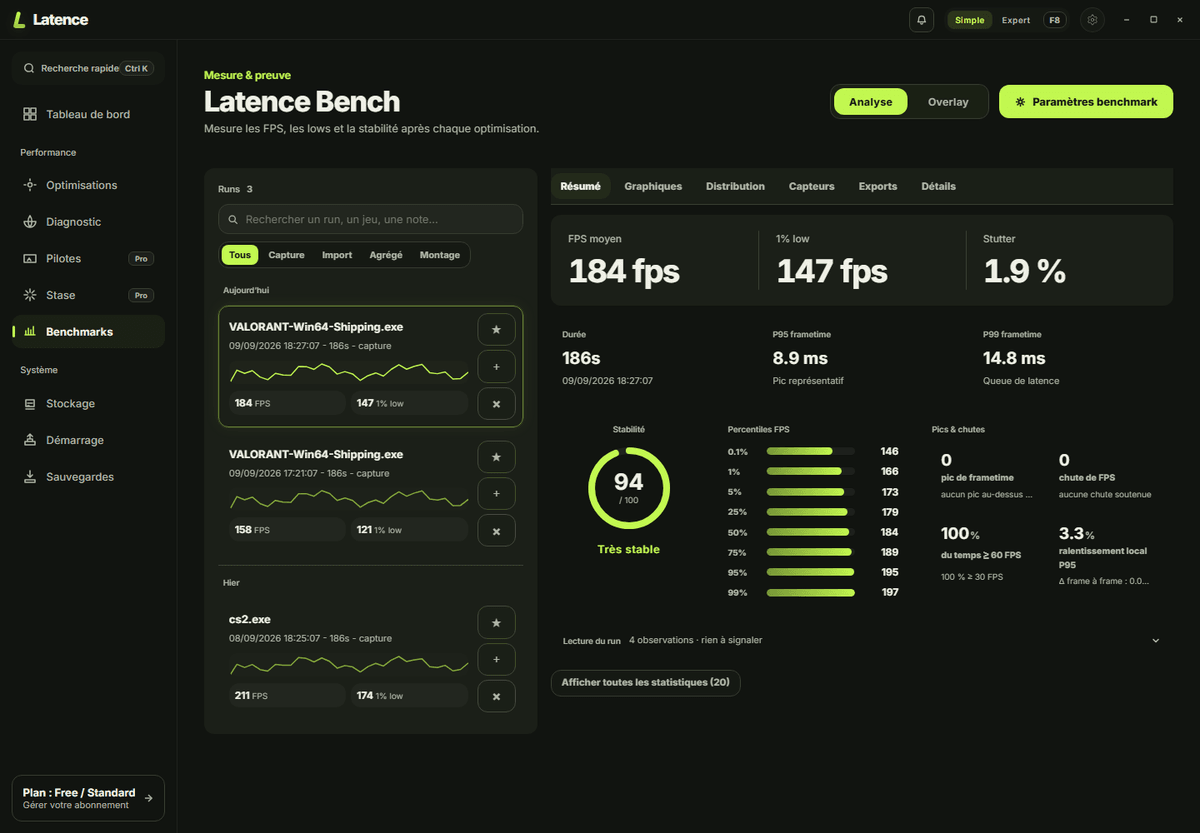
Latence's benchmark is built for this comparison. It reads the real display cadence with PresentMon, without injecting anything into the game, then compares FPS, 1% low and frametime between two sessions. Latence runs on Windows 10 (21H2 or later) and Windows 11. Full method in FPS and frametime benchmark. To roll back after a test, read Windows optimization rollback.
The real questions.
Can you still game on Windows 10 after October 2026?
Yes. Your games, Steam and your current graphics driver keep working. What stops: new NVIDIA Game Ready drivers from November 2026, and Windows fixes for PCs not enrolled in ESU. FACEIT also requires Windows 10 22H2 with ESU from October 14, 2026.
Will my NVIDIA driver stop working on Windows 10?
No. The installed driver keeps working. NVIDIA releases its last Windows 10 compatible Game Ready driver in October 2026, then only quarterly security fixes until October 2029. New games will no longer get optimizations on Windows 10.
Do you need Windows 11 to play on FACEIT?
Not yet. From October 14, 2026, FACEIT accepts Windows 10 version 22H2 with ESU enabled, until October 2027. After that, Windows 11 will be required. TPM 2.0, Secure Boot and VBS are required in every case.
Is Windows 10 ESU free?
It depends on your region. In the US, it is free if you sync your PC settings, or available for 1,000 Microsoft Rewards points or a one-time $30 purchase. In the European Economic Area, it is free while you keep signing in with your Microsoft account; otherwise updates stop after up to 60 days. ESU ends on October 12, 2027.
Is Steam dropping Windows 10?
No. Steam ended support for 32-bit Windows on January 1, 2026. 64-bit Windows 10 is still supported, and 32-bit games still run on 64-bit Windows.
Does Windows 11 give more FPS than Windows 10?
Slightly, in some tests: about 4 to 5% on average across 14 games according to TechSpot, on a very high-end PC with VBS turned off. That is not a promise for your PC. Measure the same scene before and after upgrading to find out.
Will my GTX 1060 get new drivers on Windows 11?
No. GeForce GTX 900 and 1000 series cards have only received security fixes since October 2025, until October 2028, whatever Windows version is installed.
Measure. Then upgrade.
Compare the same scene on Windows 10 and Windows 11, on your PC and in your games. That is the only result that counts.
Download LatenceSources
- NVIDIA, GeForce support plan for Windows 10: last Game Ready driver, fixes until 2029.
- NVIDIA, support plan for Maxwell, Pascal and Volta: GTX 900 and 1000.
- Microsoft, consumer ESU: coverage, conditions and dates.
- FACEIT, Windows security requirements FAQ: the October 14, 2026 rule.
- Steam hardware survey, September 2026: Windows 10 64-bit at 23.61%, all platforms combined (voluntary survey).
- TechPowerUp, Steam and 32-bit Windows: end of support on January 1, 2026.
- AMD, Adrenalin 26.9.2 release notes: supported operating systems.
- TechSpot, Windows 11 25H2 vs Windows 10: 14 games, method and test system.